

- B-102, Angol Industrial Estate, Belagavi,
Karnataka 590008, INDIA

Pressure Reducing Valves (Automatic PRV)
We are Manufacturer, Supplier, Exporter of Pressure Reducing Valves (Automatic PRV), Industrial Valves, Industrial Actuated Valves, Industrial Valve Actuators, Industrial Valve Accessories and our setup is situated in Belgaum, Karnataka, India.
We majorly target customers from ALL OVER INDIA.
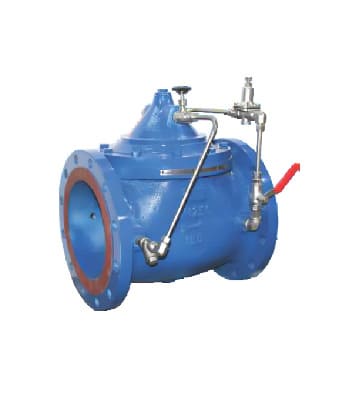
The "KONIN MAKE" Pilot Operated Pressure Reducing Valve is designed for applications where the reduction of high inlet pressures to a safe and stable outlet pressure is required. The pilot assembly reacts to changes in downstream pressure allowing the main valve to modulate between the closed and open position ensuring a constant downstream set pressure. Once the downstream pressure reaches the pilot setting, the main valve will seal shut preventing damage downstream. Pressure regulation is not dependent upon flow rate, resulting in minimal pressure loss through the valve.
| Descreption | Material |
|---|---|
| Body | DUCTILE IRON - A536/GGG50 |
| STEM | ASTM A276 TYPE SS304 |
| SEAL RING | NBR |
| SPRING | STAINLESS STEEL |
| DIAPHRAGM | STAINLESS STEEL/MILD STEEL |
| DOUBLE END BOLT | STAINLESS STEEL/MILD STEEL |
| CONTROL FILTER | STAINLESS STEEL |
| FLOW CONTROL PILOT | STAINLESS STEEL |
| BALL VALVE | STAINLESS STEEL |
| BALL VALVE | STAINLESS STEEL |
| PRESSURE REDUCING PILOT | STAINLESS STEEL |
| IP68 SOLENOID WITH MANUAL OVERRIDE(SCADA COMPITABLE) | STAINLESS STEEL |
| HIGH PRESSURE CONTROL TUBE | STAINLESS STEEL |
Design: Diaphragm valves use a flexible diaphragm to control fluid flow. The diaphragm acts as a barrier between the fluid and the valve mechanism, which helps prevent contamination and reduces the risk of corrosion or wear on internal parts.
Leak-Proof: The diaphragm provides a tight seal when pressed against the valve seat, ensuring minimal leakage. This makes diaphragm valves particularly effective for applications requiring a high degree of leak prevention.
Material Options: Diaphragm valves can be constructed from various materials, such as elastomers, plastics, and metals, allowing them to handle corrosive, abrasive, or high-purity fluids without damage.
Precise Control: Diaphragm valves offer good flow control capabilities. They can be adjusted to regulate flow rates effectively, though they are typically better suited for on/off control rather than precise throttling.
Sanitary Design: Diaphragm valves are used in applications requiring cleanliness and sterility, such as in pharmaceutical, food, and beverage industries. Their design minimizes dead space and prevents contamination.
Reduced Maintenance: The design of diaphragm valves often allows for self-cleaning action, which helps to prevent buildup of debris and reduces maintenance needs.
Configuration Options: Diaphragm valves come in various designs, including straight-through, angle, and weir types, making them adaptable to different flow requirements and installation constraints.
Simple Servicing: Maintenance is generally straightforward. The diaphragm can be easily replaced or serviced without removing the valve from the pipeline, which minimizes downtime.
Versatility: Diaphragm valves are available in a range of materials and designs to handle different temperatures and pressures. It’s important to select a valve that matches the specific operational conditions.
Control Options: Diaphragm valves can be operated manually with a handwheel or automatically with electric or pneumatic actuators, providing flexibility for different types of systems.
Design Efficiency: Many diaphragm valves are designed with minimal dead space, reducing the chance of fluid stagnation and contamination.
Flow Path: The flow path through diaphragm valves can be affected by the type of diaphragm and valve body design. They are generally optimized for smooth flow but may introduce some turbulence depending on the specific design.
Material Selection: Depending on the diaphragm and valve body materials, diaphragm valves can handle a wide range of chemicals, including aggressive or hazardous substances.
Thermal Expansion: Some diaphragm materials may be sensitive to temperature changes, which can affect their performance. Choosing the right material for the expected temperature range is important.
Customization: Diaphragm valves can be customized with different types of diaphragms, body materials, and actuators to meet specific application requirements.