

- B-102, Angol Industrial Estate, Belagavi,
Karnataka 590008, INDIA

Knife Edge Gate Valves
We are Manufacturer, Supplier, Exporter of Knife Edge Gate Valves, Wafer Type, Lugged Type Knife Edge Gate Valves, Industrial Valves, Industrial Actuated Valves, Industrial Valve Actuators, Industrial Valve Accessories and our setup is situated in Belgaum, Karnataka, India.
We majorly target customers from ALL OVER INDIA.
These are widely used in Process Industries such as Water Treatment Systems, Wastewater Treatment Systems, Oil And Gas Industries, Petrochemical Industries, Chemical Processing Industries, Power Generation, Water Distribution and Utilities, Pulp And Paper Industries, Food Industries, Beverage Industries, power plant, pharmaceutical Industries, manufacturing Industries, Mining Industries, Mineral Processing Industries, steel Industries, metal processing industry, chemical industries.
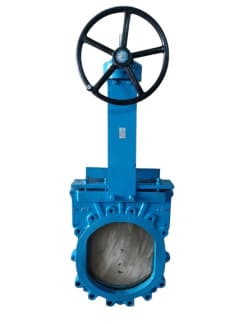
| Sizes | 2" to 32" (50 mm to 800 mm) |
|---|---|
| ASME Class | Class 150 and PN 10 |
| Design Standard | MSS SP 81 |
- Size : 50mm to 800mm
- Type : Uni – directional / Bi- directional
- Material : CI, DI, WCB, CF8, CF8M, CG3M, CF3M
- Ends : Wafer, Lugged
- Operation: Hand-wheel, Chain- wheel, Gear, Lever, Pneumatic or Electric Actuator
- Specials: Extended Stem, Closed Bonnet, Deflector cone, Soft seated, Purge connection
- Testing: As per MSS – SP 81
- Sharp heavy-duty knife edge at the bottom of gate cuts through solid sediments and ensures reliable shut-off
- Gate offered with surface coatings based on customer demand - Hardfacing, Nitriding, Chrome-plating
- Replaceable seats - Easy maintenance at site. Longer service life
- Low operating torque - Facilitates use of a smaller-size actuators. Lower Initial Investmen
Cutting Ability: Knife edge valves feature a sharp-edged gate or blade that can cut through slurries, sludges, and other thick or viscous materials. This design helps in effectively handling media that can clog or obstruct other types of valves.
Seal Integrity: These valves are designed to provide a tight seal when closed. The knife-edge gate presses against a resilient seat to minimize leakage, making them suitable for applications requiring a reliable shut-off.
Robust Design: Knife edge valves are typically constructed from durable materials such as stainless steel, cast iron, or alloys. This robust construction makes them suitable for harsh environments and demanding applications.
Material Suitability: The valve’s design allows it to handle abrasive and corrosive media effectively. The sharp edge can cut through abrasive materials, reducing wear and extending valve life.
Regulation Capabilities: While primarily designed for on/off control, knife edge valves can also provide throttling control to some extent. However, they are typically not as precise as other types of control valves for flow regulation.
Wide Usage: Knife edge valves are used in a variety of industries, including wastewater treatment, mining, paper and pulp, and chemical processing. They are suitable for applications where handling of thick or viscous fluids is required.
Actuation Options: Knife edge valves can be operated manually with a handwheel or lever, or automatically using electric, pneumatic, or hydraulic actuators for remote control.
Compact Design: Knife edge valves often have a compact and straightforward design, making them suitable for installations in confined spaces or where vertical space is limited.
Simple Upkeep: Maintenance of knife edge valves is generally straightforward. The gate and seat can often be accessed and serviced without removing the entire valve from the pipeline.
Operational Smoothness: The knife edge gate slides smoothly through the valve seat with minimal friction, which is particularly useful for handling viscous materials.
Flow Efficiency: Knife edge valves are designed to minimize pressure drop across the valve, ensuring efficient flow of media with minimal energy loss.
Material Options: The materials used for the gate and seat can be selected based on the type of media being handled, ensuring resistance to wear and extending the valve’s service life.
Configurations: Knife edge valves come in various configurations, including straight-through and oblique designs, to suit different application requirements and pipeline layouts.
Versatility: Knife edge valves are available in different temperature and pressure ratings, allowing them to be used in a range of operational conditions.
Leak Prevention: The design of knife edge valves includes features to prevent leakage and ensure safe operation, such as robust sealing materials and construction.