

- B-102, Angol Industrial Estate, Belagavi,
Karnataka 590008, INDIA

Cast Steel Two Piece / CS 2 Piece Ball Valves
We are Manufacturer, Supplier, Exporter of Flanged End, Screwed End, Socket End, Butt Weld End Cast Steel Two Piece Ball Valves, CS 2 Piece Ball Valves, Industrial Valves, Industrial Actuated Valves, Industrial Valve Actuators, Industrial Valve Accessories, CS Ball Valves, Two Piece Flanged Ball Valves and our setup is situated in Belgaum, Karnataka, India.
We majorly target customers from ALL OVER INDIA.
These are frequently employed in process control systems where precise flow control is required. They can be used to regulate the flow of various fluids, including liquids, gases, and slurries, in Process Industries such as Oil And Gas Industries, Chemical Processing Industries, Pulp And Paper Industries, Food Industries, Beverage Industries, Glass Manufacturing Industry, Steel Industries, Petrochemical Industry, Power Generation Industries, Marine Applications, Water Treatment, Wastewater Treatment.
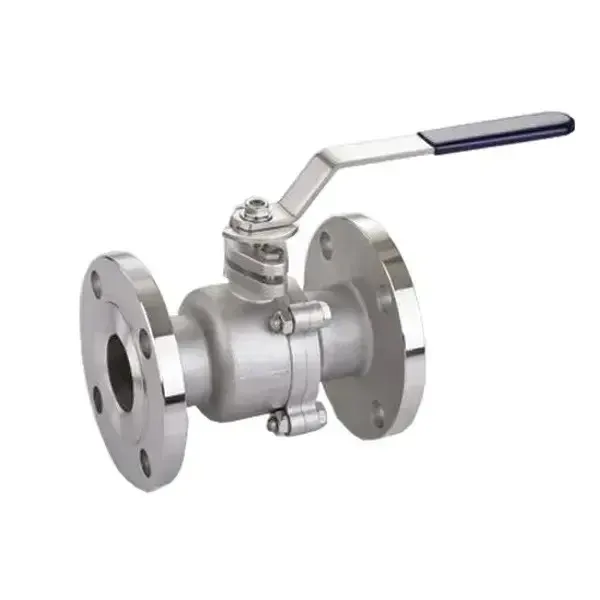
Two Piece Reduced and Full Bore
| Sizes in mm(Inch) | Pressure Rating |
|---|---|
| 15 (1/2') to 300 (12') | Class 150, 300 |
| 15(1/2') to 150 (12') | Class 600 |
| 15 (1/2') to 65 (2') | Class 900 & 1500 |
| Design Std | BS EN ISO 17292 (BS 5351) |
| Face to Face | ASME B16.10 EN 558-2 |
| Testing Std. | API 598, BS 6755-1, EN 12266-1 |
| Body Material | WCB , CF8, CF8M, Duplex etc. |
| Ball | CF8, CF8M, Duplex etc. |
| Seat | PTFE, CFT, GFT, PEEK, Delrin, Nylon & Metal. |
| Stem Material | 410, 304, 316 etc |
| End Connection | Flanged, Screwed, Socket & Butt Weld. |
Easy Maintenance: The valve body is split into two sections, typically a main body and end caps that can be bolted together. This modular design allows for easier maintenance and repair, as the valve can be disassembled without removing it from the pipeline.
Flexible Configurations: Two-piece ball valves can be configured with various end connections (e.g., threaded, flanged, or welded) and can accommodate different sizes and pressure ratings, making them versatile for different applications.
Simplified Service: If a component fails or requires servicing, the end caps can be removed to replace internal parts or perform maintenance, often without disturbing the pipeline or removing the entire valve.
Affordable Choice: Generally, two-piece ball valves are more affordable compared to single-piece or three-piece designs, making them a cost-effective choice for many applications.
Dependable Sealing: They provide reliable sealing and can handle a range of pressures and temperatures, depending on the materials and design specifications.
Minimized Leakage: While they have more joints compared to single-piece designs, modern two-piece ball valves are designed to minimize leakage with the use of high-quality seals and gaskets.
Space Efficiency: Two-piece ball valves are typically more compact than their three-piece counterparts, which can be beneficial in applications where space is limited.
Balanced Design: The design provides a balance between strength and durability, suitable for many industrial and commercial applications.
Adaptable Features: The valve can be configured with various options for actuator types, handles, and additional features like lockouts or position indicators.