

- B-102, Angol Industrial Estate, Belagavi,
Karnataka 590008, INDIA

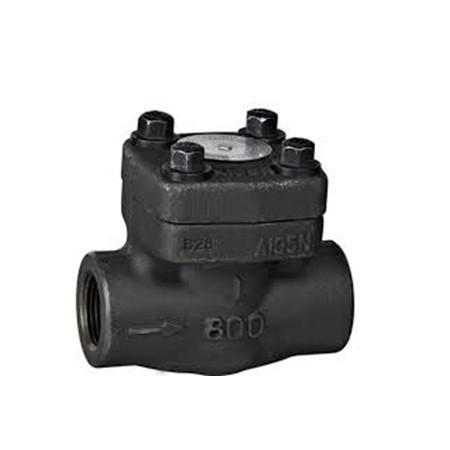
Forged Check Valves
We are Manufacturer, Supplier, Exporter of Forged Check Valves, Flanged End Forged Check Valves, Screwed End Forged Check Valves, Socket End Forged Check Valves, Butt Weld End Forged Check Valves, Industrial Valves, Industrial Actuated Valves, Industrial Valve Actuators, Industrial Valve Accessories and our setup is situated in Belgaum, Karnataka, India.
We majorly target customers from ALL OVER INDIA.
These are widely used in Process Industries like Water Treatment Systems, Wastewater Treatment Systems, Oil And Gas Industries, Petrochemical Industries, Chemical Processing Industries, Power Generation, Water Distribution And Utilities, Pulp And Paper Industries, Food Industries, Beverage Industries, Dairy Industry, Steel Industries, Food Industries, Beverage Industries, Power Plant, Pharmaceutical Industries, Manufacturing Industries, Glass Manufacturing Industry, Steam Systems, Refining Industries, Processing Industries, Mining Industries, Mineral Processing Industries, HVAC Systems, Chemical Industries.
| Sizes in mm (Inch) | Pressure Rating |
|---|---|
| Screwed, Socket & Butt Weld Ends | |
| 15 (1/2") to 50 (2") | Class 800 & 1500 |
| 15 (1/2") to 25 (1") | Class 2500 |
| Flanged Ends ( Weldon Flanges) | |
| 15 (1/2") to 50 (2") | Class 150, 300 & 600 |
| Design Std | API 602, BS 5232 |
| Face to Face | ASME B16.10 |
| Testing Std. | API 598/EN 1266-1 |
| Body & Bonnet | A105, F11, F22, F5, F9, F304 & F316 |
| Disc | CA15, CF8, CF8M |
| Stem | 410, 304, 316 |
| Seat | 410, 304, 316 |
| End Connection | Flanged, Screwed, Socket weld Ends |
| End Detail | For SE – BS:21 (Parallel/ Taper) / ASME B1.20.1 (NPT) Threads, SWE B16.11 |
Function: Check valves are designed to allow fluid to flow in only one direction. They automatically close to prevent reverse flow, ensuring that fluids do not flow backward through the system.
Mechanism: These valves operate automatically based on the flow direction and pressure. They do not require manual operation or control, which simplifies their use and integration into systems.
Swing Check Valve: Uses a hinged disc or flap that swings to open or close. It's suited for applications with lower pressure drops but can be noisy.
Lift Check Valve: Features a disc or ball that lifts and falls to control flow. Provides low pressure drop and is effective in high-pressure applications.
Ball Check Valve: Utilizes a ball that seals against the valve seat to prevent backflow. Simple in design and reliable.
Diaphragm Check Valve: Uses a flexible diaphragm to seal and prevent reverse flow. Ideal for handling corrosive or abrasive fluids.
Dual Plate Check Valve: Employs two spring-loaded plates that open and close with the flow. Designed for high flow rates and minimal pressure drop.
Design: Various sealing mechanisms include discs, balls, or diaphragms, depending on the valve type. The choice of mechanism affects the valve’s sealing performance and suitability for different media.
Construction: Check valves are available in a variety of materials such as metals (stainless steel, brass, bronze) and plastics (PVC, CPVC). Material choice depends on the fluid being handled and operational conditions.
Pressure Drop: Check valves can introduce a small pressure drop due to the flow restriction caused by the sealing mechanism and valve design.
Flow Direction Sensitivity: Some check valves are sensitive to the direction of flow and must be installed accordingly.
Guidelines: Most check valves need to be installed in a specific orientation to function correctly. For example, swing check valves should be installed in a horizontal position, while others may have less restrictive orientation requirements.
Capacity: Check valves are designed to handle specific levels of backpressure. Excessive backpressure can lead to valve malfunction or damage.
Simplicity: Check valves generally require minimal maintenance due to their simple design. Regular inspection is recommended to ensure proper operation and to replace worn components if necessary.
Application: Check valves are used in a wide range of applications, from water and wastewater systems to industrial processes and chemical handling. Their design and material options make them adaptable to various fluids and operating conditions.
Considerations: Some check valves, especially swing check valves, can generate noise and vibrations due to the disc or flap moving. Selecting the appropriate type and material can help mitigate these issues.
Limitations: The velocity of the fluid passing through the check valve can affect its performance. Some designs are better suited for high-velocity applications than others.